Building elite football athleticism
Fascial Integration Training
Unlock the strength, stamina, and speed of a world class footballer by cleaning up the biomechanical dysfunctions holding you back through the Five Phases of Fascial Integration Training.
Why Fascia?
Some “experts” say fascia doesn’t exist. Modern science really didn’t start studying it seriously until better forms of cadaver preservation and tissue research was available. Before that fascia was considered an inert stuffing tissue that was previously tossed out during research in favor of looking at the muscles, organs, bones, and other tissue deemed more important.
After years of going down every rabbit hole of modern sports science as an ambitious youth footballer and experiencing a multitude of catastrophic injuries as a professional footballer, I realized that the football world is backwards, in more ways than one.
And when you open your eyes to the fact that about 99% of training advice footballers receive actually leads to the countless injuries nowadays, it starts to make a whole lot of sense.
So after 15+ years of research, trial & error, and now clinical work with thousands of clients, I’m proud to share with you the ultimate training system for footballers to prevent/fix injury and improve every performance metric by working with nature and retracing your steps through the development arc every top athlete of every sport unknowingly went through during childhood.
Revolutionizing Sports Performance
The conventional medical system and sports science tells athletes to get in the gym, lift heavy, and “strengthen” until the cows come home. Then when they get injured over and over again, it’s bad luck, they blame the grass, or the ultimate excuse: too many games (when there are barely more games than there used to be, for the top 1% of professional players).
We’ve created a comprehensive training system that transforms footballer’s athleticism by stimulating the fascial system which creates permanent changes at the cellular level so you can forget about the endless cycle of stretching, mobility work, and delayed onset muscle soreness.
Put simply, the modern strength and conditioning world hyper-fixates on meaningless statistics, band-aid approaches, and symptom-based training because it’s easy to say “this athlete got bigger” or “this athlete worked really hard in the gym”.
We prefer to treat the root cause and focus on the whole. This leads to permanent transformational results that separate you from the rest of the football world.
The Five Phases of Fascial Integration Training
We have separated this process into five phases that you take through each layer of fascial remodeling in order to develop comprehensive mastery of every juncture in the human body.
This training system has created thousands of elite athletes that dominate the football pitch, glide effortlessly for 90 minutes, and above all, have more fun than any other footballer.
Because when you are having fun, you are playing your best. Any biomechanical dysfunction is going to slow you down, decrease your movement capability, and take you out of the flow state.
Phase 1 — The Root Protocol
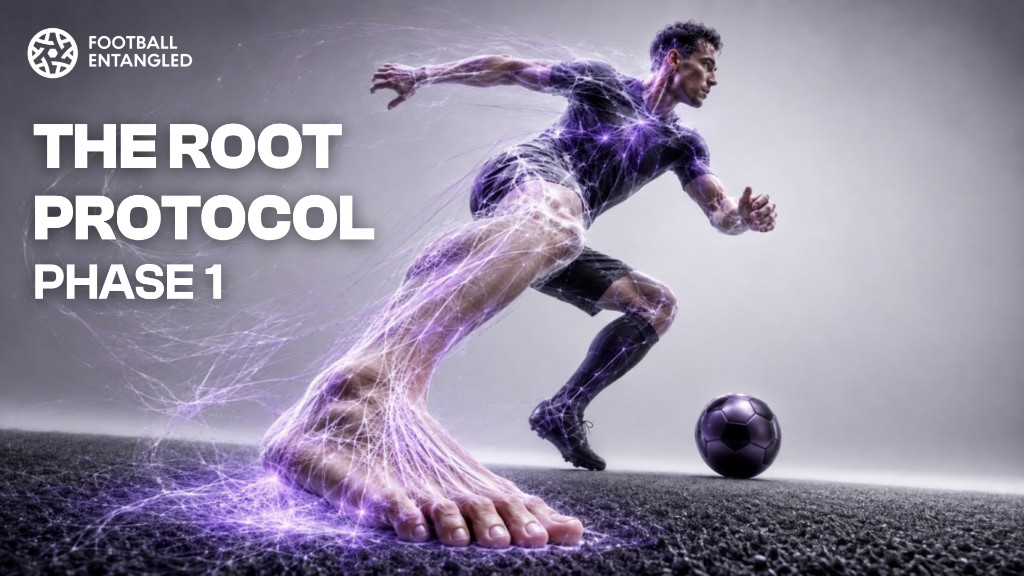
Your feet are the only connection to the ground and no one trains it.
Most are sabotaging it with modern cushioned sneakers, and even worse have an incorrect model of how the foot functions. Imagine a car with no tires…
This leads to a multitude of injury because the fascia in the foot is your brain’s only way to sense the ground and coordinate muscle activation in the rest of the body.
When the foot isn’t functioning right, you will experience worse:
- Balance, stability, and proprioception
- Power production, stamina, and explosiveness
- Agility, quickness, and sprint speed
- Coordination and technique (shooting, passing, dribbling, crossing, and heading)
Put simply, foot function is critical for all football attributes. If the fascia isn’t integrating the whole body from the feet then the whole entire body isn’t going to work together. So how do we fix this? We remodel the feet in several key areas:
- Toe Retraction Better Glute Function More Explosive First Step
- Ball of the Foot Expansion Stronger Contact Point Cut, Accelerate, and Change Direction with More Force
- Nerve Stimulation Mind-Body Connection Better First Touch and Ball Control
- Sole of the Foot Stronger & More Stable Feet Transfer More Force into the Ground and Leave Defenders Behind
By Day 90 — Feel the difference every time you step onto the pitch
- Explode faster — A central contact point lets you put more force into the ground so your first few steps are quicker and more powerful.
- Cut harder — An expanded forefoot lets you change direction without leaking speed or force.
- Stay stronger on the ball — Better balance and stability make it harder for defenders to knock you out of position.
- Control the ball more naturally — A more stable connection to the ground gives the rest of your body a better platform for first touch and technical skills.
- Trust your body — Remodeling the structure of your feet will enable you to better tolerate the forces of sprinting, cutting, landing, and contact.
Your feet are the origin point of every sprint, cut, jump, touch, and strike you make. If that connection is weak, unstable, or unable to transfer force, everything above it has to compensate.
The Root Protocol rebuilds that athleticism by restoring the natural foot function modern shoes, sedentary living, and mainstream weight training have taken away.
If you want to train your fascia, this is where it starts.
The result: a stronger connection to the ground, more force into every movement, and a body that can finally express more of the athleticism you already have.
Key benchmarks we are looking for to signal mastery
- Full toe dexterity and retraction
- A widened forefoot and straight toes
- Singular contact point on the ball of the foot
And able to display proficiency of The Root Protocol:
- Glute sensations and Myofascial Activation in Towel Retractions.
- Big Toe Retraction and Ball of the Foot Expansion in Thumbtack.
- Foot Pressure Tolerance in Standing on Air.
Phase 2 — Fascial Loading
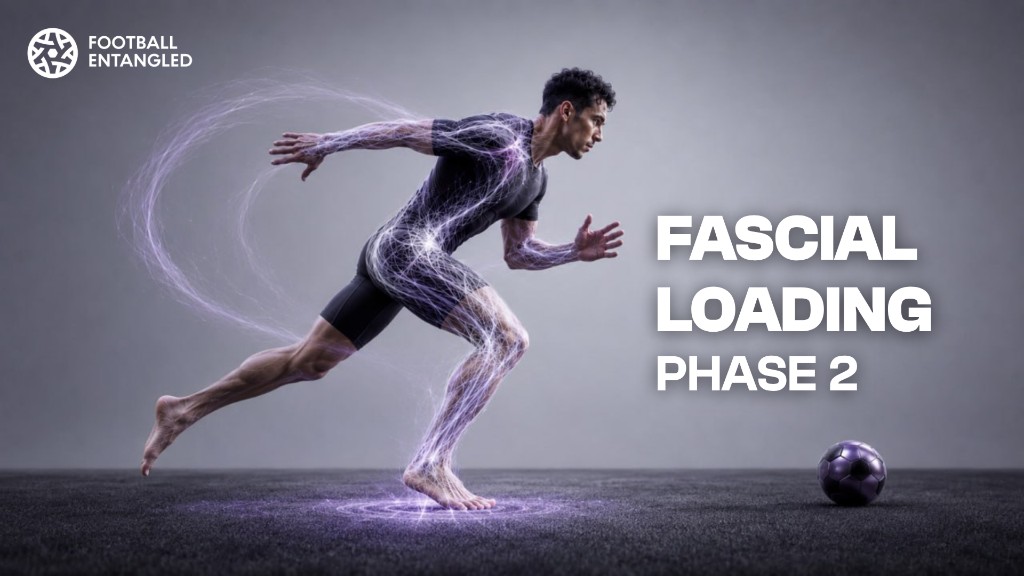
The problem here is that the entire football world trains concentric strength and hypertrophy in the gym, but forgets about eccentric loading and elasticity.
That’s like having the biggest turbos in the world but never training your engine or even considering your brakes. Without the ability to brake, I guarantee you will crash.
And that’s why we have so much injury nowadays but they conveniently blame misfortune or the amount of games (even though there aren’t that many more games for a large majority of players). Yet the severity and quantity of injuries are getting worse every single season.
If you can’t absorb more force than you can produce, you will get injured and perform below your potential.
The solution is to change how your body absorbs force.
Instead of force going into the joints and muscles, your fascia will become the main force absorber.
The key here is the ankles. When they lock up with myofascial activation each time your forefoot hits the ground, force loads into the fascia — not the bones and muscles.
We build that ankle stiffness by developing:
- Extensor Tendon Strength Stronger, Springier Feet Accelerate and Push Off the Ground with More Power
- Anterior Tibialis Strength Greater Ankle Stiffness & Single-Leg Control Run Harder and Stay Balanced at Top Speed
- Fascial Elasticity Absorb & Recycle More Force Sprint, Jump, and Change Direction Effortlessly
- Foot-to-Glute Connection Holistic Force Transfer Up the Chain Get More Power from Your Posterior Chain Every Time You Accelerate
By Month 6 — Feel lighter, springier, and more explosive every time you step onto the pitch
- Accelerate with precision — Stronger, more elastic ankles return more energy into the ground so every stride propels you forward.
- Cut harder and run faster — Better ankle stiffness gives you a stronger platform to absorb force, plant, and explode all across the field.
- Stay dangerous late into matches — Recycling energy means your calves and quads don't have to muscle through every movement.
- Unlock more lower-body power — Better force transfer from the ground up allows your glutes to contribute more effectively when sprinting, jumping, and changing direction.
- Trust your ankles under pressure — Stronger feet and ankles give you more confidence during hard cuts, awkward landings, and physical challenges.
Great athletes don't muscle their way through every movement. They absorb force, recycle it, and unleash it again.
Fascial Loading builds that elastic quality so you can stop fighting the ground and start using it as a springboard.
The result: more bounce, more speed, less wasted energy, and an athletic engine that stays explosive deeper into matches.
Key benchmarks we are looking for to signal mastery
- Prominent extensor and anterior tibialis tendons
- Developed lateral calf
- Firm glutes during movement
And able to display proficiency of Fascial Loading:
- 5 minute two-legged hop with myofascial activation and primarily glute sensations.
- 90 second single-leg hop with myofascial activation and primarily glute sensations.
- Can jog for 30 minutes with only glute and core sensations.
Phase 3 — Spiral Drive
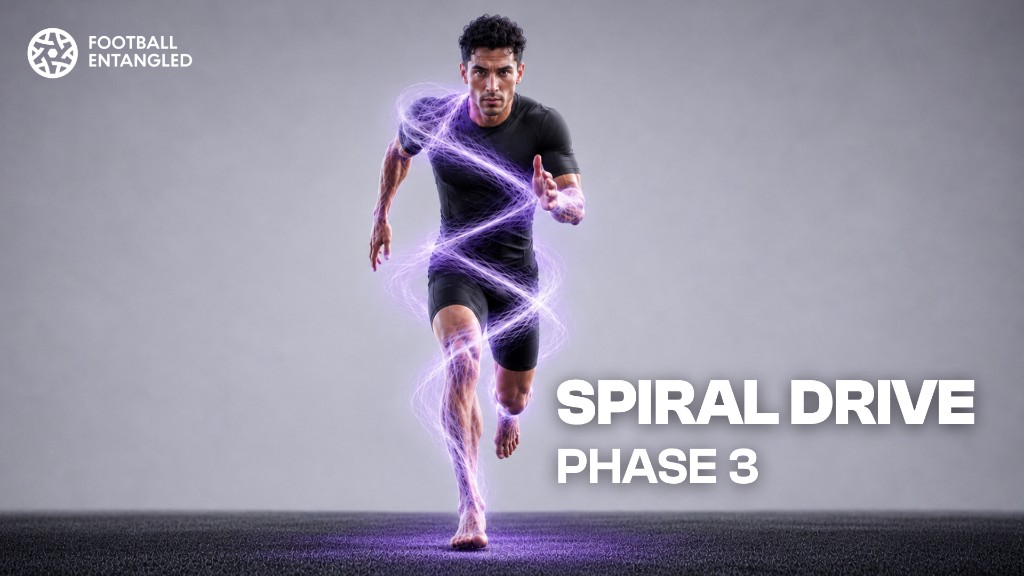
Once you’ve built the foot-to-glute connection and your feet/ankles actually work, let’s talk about the elephant in the room: how you move.
Trainers tell you to do:
- Core training → stiffening your spine and hips.
- Swing your arms like a robot → teaching your spine and shoulders to be rigid.
- Hip mobility → arbitrary and excessive movements unrelated to the gait cycle.
And no one talks about: powerful, spiraling hips that recycle energy and propel you forward. Your hips sit at the center of nearly every explosive action you make — sprinting, cutting, dribbling, striking, jumping, and holding off defenders. And the key is function not mobility (which will actually create better mobility). Here’s how we do it:
- Back Chain Dominance Hips behind the rib cage A deeper level of movement efficiency and athletic mobility. Helps a lot with tight hips and weak glutes.
- Pelvic Tilt Strength in both anterior and posterior pelvic tilt — two essential ranges of motion in the gait cycle Stabilize in single-leg positions and run faster. Great for tight hamstrings and weak hip flexors.
- Deeper Glute Function Learning the hip hike Powerful change of direction and nimble movement so you can avoid tackles as well as nasty non-contact injuries. This is what stops most footballers from becoming elite dribblers.
By Month 9 — Your movement starts looking and feeling different
- Accelerate more powerfully — Better hip positioning allows you to generate and tolerate more force as you propel yourself forward.
- Change direction without losing speed — Greater pelvic control helps you stay strong in single-leg positions as your weight shifts and you need to redirect force.
- Become harder to tackle — Better control through your hips gives you more options to shift, rotate, and escape defenders without losing your balance.
- Dribble more fluidly — Instead of your upper and lower body moving like one rigid block, your hips can adapt to the ball, defender, and space around you.
- Move with freedom — Stronger hip function means less stiffness, more mobility, and more confidence sprinting, cutting, and reaching.
Speed isn't just about how much force you can produce. It's about how effectively your body can transfer and recycle that force.
Spiral Drive gives your hips the strength, control, and freedom to turn that elasticity you've built into usable athletic power and beautiful biomechanics so you can outperform and outlast every opponent.
The result: more explosive acceleration, sharper changes of direction, fluid dribbling, and movement that finally looks athletic instead of robotic.
Key benchmarks we are looking for to signal mastery
- Eye test — sprinting video: you need to look good. Pure and simple.
- Proper ankle landing — contact point — ankle lock — no heel strike
- Femur internal rotation and external rotation
- Spinal flexion — head over toe
- Facial expression
And able to display proficiency of Spiral Drive:
- Articulate anterior and posterior pelvic tilt.
- Glute function to go in and out of the hip hike.
- Ability to maintain center of mass on the ball of the feet while the hips remain behind the rib cage.
Phase 4 — Midline Mechanics
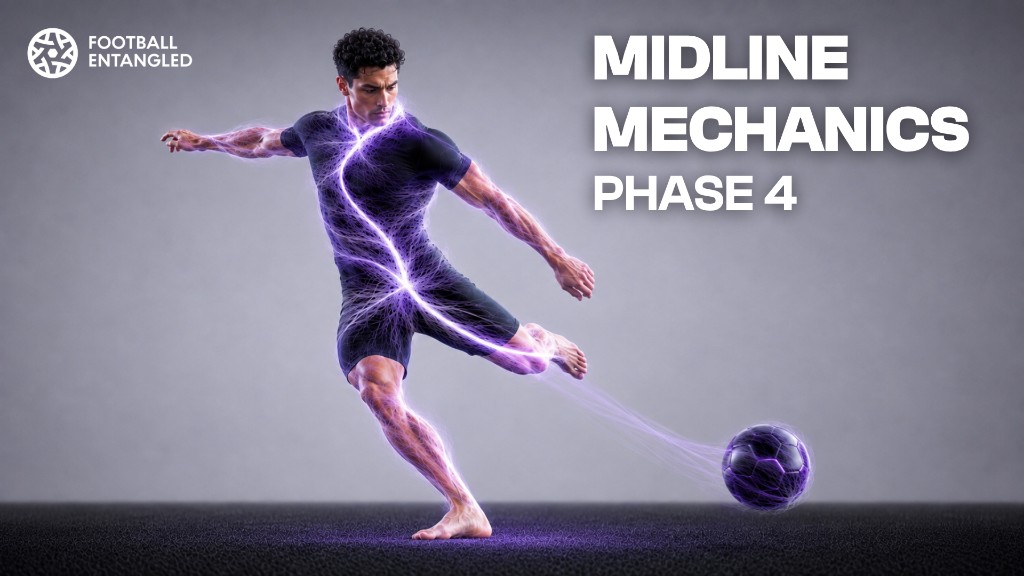
What’s the next lie athletes are fed? Core training.
Trainers tell footballers to do sit-ups, planks, and other variations of stiffening the core and excessive abdomen flexion.
Which, in case you didn’t see coming, has nothing to do with athleticism.
Do you ever stiffen your core when running? No.
Actually the opposite:
- The spine is supposed to laterally flex back and forth.
- The head is supposed to move head over toe.
- The shoulders are supposed to rotate internally and externally.
- The pelvic floor is supposed to expand as you inhale and contract as you exhale.
The quality of all of that happening decreases the more you brace your core. And that’s what every trainer, strength coach, and physio wants you doing. Crazy. And excessive abdomen flexion? You don’t run hunched over. So how do you build true core strength? You must connect everything we built in the first three phases:
- Your feet have been remodeled to absorb force.
- Your ankles have been strengthened to create elasticity.
- Your glutes have been connected to the feet to produce force.
And your hips can now cycle all that force to create greater power. But if your upper and lower body aren’t working together, you’re still leaving speed, stamina, and strength on the table. Midline Mechanics builds true integrated core strength so force can travel through your entire body when you sprint, strike, cut, rotate, and battle opponents. We do this by training:
- Midline Control Connect Your Upper & Lower Body Transfer More Power into Sprinting, Cutting, and Striking
- Breathing & Nervous System Regulation Stay Relaxed, Stand Taller, and Better Blood Flow to Muscles Move Smoothly and Make Better Decisions When Fatigued
- Spinal Lateral Flexion Restore Natural Side-to-Side Movement Run More Fluidly and Change Direction Without Becoming Rigid
- Rotational Strength Create & Control Force Through Your Torso Strike Harder, Sprint Faster, and Hold Off Defenders
By Month 12 — Your entire body starts working as one athletic system
- Strike the ball with more power — Your hips and torso can rotate together to create the whip that transfers speed through your body and into the ball.
- Win more physical challenges — Integrated strength from the ground through your torso makes it harder for opponents to knock you off the ball.
- Run more fluidly — Your shoulders, spine, hips, and legs can counter-rotate naturally instead of fighting against each other.
- Stay composed under pressure — Better breathing and nervous-system control help you remain relaxed instead of becoming tense and wasting energy.
- Express more power from the strength you already have — Instead of isolated muscles fighting one another, all your muscles learn to work together multiplying your strength.
The strongest footballer isn't necessarily the one who can lift the most weight. It's the one who can express strength the fastest with precision.
Midline Mechanics connects the pieces we've spent the previous phases building.
The result: rotational power, stronger physical presence, smoother running, harder strikes, and a body that moves as one coordinated athletic system.
Key benchmarks we are looking for to signal mastery
- Spine, head, shoulders, and arms spiral as you run.
- Natural core activation in exercises, running, and football technical skills like shooting, passing, and crossing.
- Ability to breathe into and consciously control the pelvic floor.
And able to display proficiency of Midline Mechanics:
- Perform Lateral Bounds w/COD with proper landing mechanics and rotational explosiveness.
- Execute all yoga ball exercises with smoothness and control.
- Execute rotational banded fascial work with adeptness.
- Perform the bear crawl hold for 3 minutes with minimal quad burning.
Phase 5 — Athletic Mastery
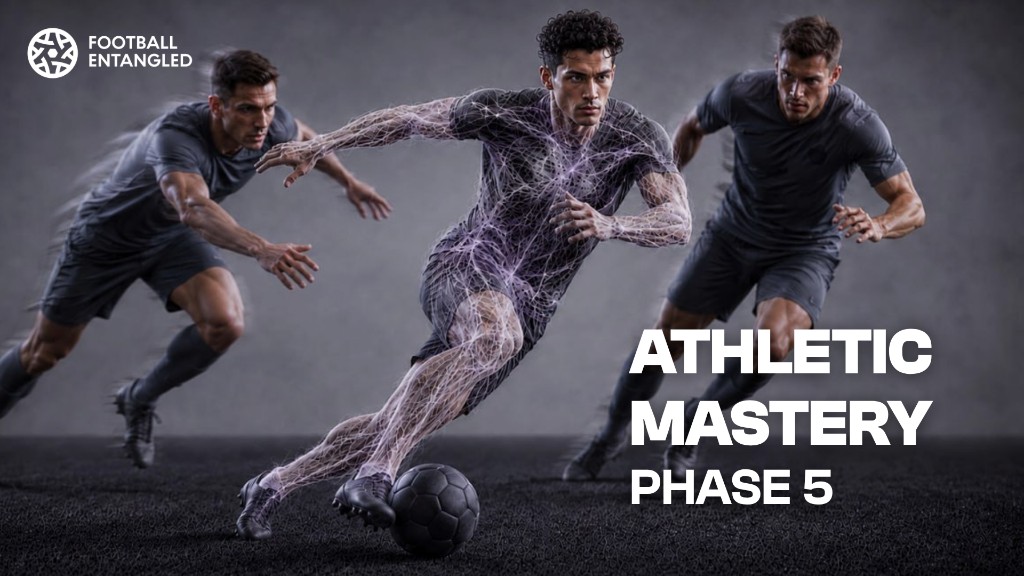
Now we take everything you've built and teach you to use it at full speed, under pressure, and in unpredictable situations.
Because football isn't played slowly. Everything needs to work automatically.
You don't know exactly when you'll need to sprint, cut, jump, reach, collide, rotate, or react. Your body has to solve those problems instinctively while you're focused on the game.
Athletic Mastery bridges the gap between having athletic ability and being able to express it when it matters.
We do this through:
- Dynamic & Reactive Coordination Faster Muscle Activation and Organization Run Faster past Defenders, Change Direction with Grace, and Execute Complicated Skills Easily
- Maximal Force Transfer Condition Muscles at Max Intensity Unlock Your Fastest Sprinting and Compete Physically at The Highest Level
- Movement Vocabulary Teach Your Body More Ways to Solve Movement Problems Stay Balanced and Dangerous in Unpredictable Situations
- High-Speed Integration Combine Everything Under Pressure Express Your Athleticism Instinctively Without Thinking
By Month 15 — Stop thinking about movement and start expressing it
- Explode when opportunities appear — Your body can access its speed and power instinctively when a defender gives you half a yard.
- Glide past opponents — More movement options allow you to react, cut, rotate, and accelerate without becoming stiff or predictable.
- Stay powerful for 90 minutes — Efficient movement and better force management help you preserve energy and athletic quality deeper into matches.
- Become harder to knock off the ball — Your entire body can absorb and redirect contact instead of losing its structure when challenged.
- Perform with the physical qualities coaches and scouts notice — Speed, fluidity, explosiveness, coordination, physical presence, and the ability to consistently dominate matches.
Think of the first four phases as building a supercar.
Phase 1 → The Tires
Phase 2 → The Brakes
Phase 3 → The Axles
Phase 4 → The Engine
Athletic Mastery teaches you how to drive it (and add some turbos).
We're taking the feet, ankles, hips, spine, core, and nervous system we've spent months integrating via the fascia and exposing them to the speed, force, chaos, and the unpredictability of football.
The result isn't simply a stronger or faster footballer. It's an athlete who can access their full physical potential when the game demands it.
Key benchmarks we are looking for to signal mastery
- Match winning performances
- Lightning speed, power, and explosiveness
- Elite technical ability (shooting, passing, and dribbling)
And able to display proficiency of Athletic Mastery:
- 4.6 seconds 40m sprint time
- 11.3 seconds 100m sprint time
- 24.5 seconds 200m sprint time
After 15 months of incorporating all five phases of fascial integration, you'll have everything in place to be an elite footballer — dominating matches, waking up refreshed and more athletic the morning after, and getting looks from bigger clubs.
Why You Need This System
I’ve built this training system over the last 15+ years playing professional football and now coaching thousands of footballers across the world. I’ve reverse-engineered world class players and put together a blueprint to build their athleticism layer by layer.
The key understanding is this is all about permanent change in your body, mind, and spirit to reach the most athletic, dominant, and ambitious version of yourself.
It is not designed to simply make you tired, break a sweat, or burn some calories.
You can use it to maximize every aspect of your performance and fix the root cause of all injuries.
Hope you enjoy.
Start Fascial Integration Training
If you are ready to unlock world-class strength, stamina, and speed by cleaning up the biomechanical dysfunctions holding you back, start Fascial Integration Training today.
Pick Your Plan